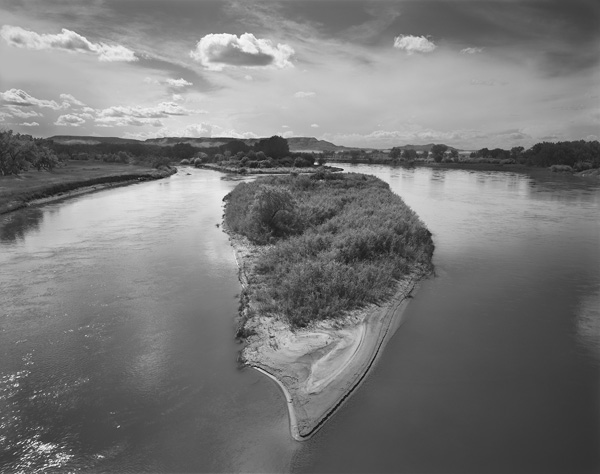
Near Judith Landing, Missouri River, Montana
Days Photographing in Montana are the most interesting of times in the field. I met weather, people, and a land which has become more intriguing to me as a still photographer with each exposed frame.
A rancher (farms west of the Missouri River are called ranches), told me in no uncertain terms, that the reason ”God man eastern Montana flat, so that balage (rolled hay), would not roll and fall into the Missouri River.”
I work the Montana landscape along farm roads, those dotted lines on a map without a route number, which greatly exaggerates which part of Montana you are actually in. I was trapped by a violent hail storm, which put chips in my windshield, and left the sky a dramatic scene.
Most spaces in the Western landscape, are perfect for the looking part of photography. It can take days of looking to find all the surprises the next hill might oblige. As best nature tries, the Montana landscape is human built. Its design is squarish, sometimes round, with long lines pretending to be roads, broken up only by the occasional cattle guard.
Photography always starts in the morning. Often, where two roads cross, like the town of Winnett, Montana. Winnett has four occupants, a convenience store wanting to be a super market, a motel with no T.V., a cafe with transparent coffee, and a cowboy bar.
All are fossils.
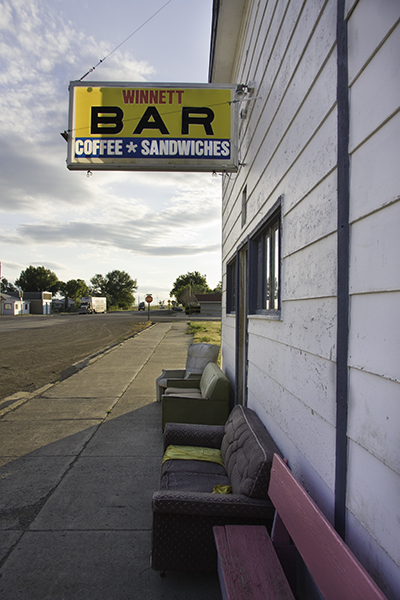
Cowboy Bar, Winnett, Montana
You move out early, real early, when the light has barely touched the dirt, and when the wind has not yet woken, and even the locals have not lifted their shades. The day moves you along the edges of fields, ready to be cut, and cut. Some parts of the landscape have wrangled back their wildness, while nesting against broken tractors, and abandoned farm implements.
You hope your eyes tire from looking, or, was that afternoon nap, late. Now, don’t take too long a nap, just enough for you to judge the arc of sun, making new shapes on the horizon.
A Montana horizon.
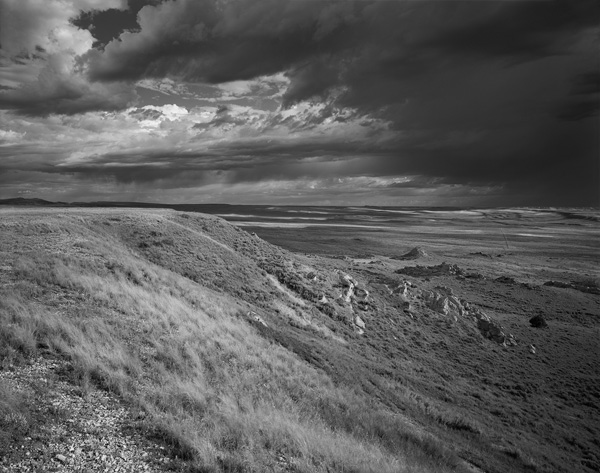
Golden Valley, East of Roundup, Montana
©Copyright Craig Carlson All Rights Reserved 2012