26. February 2012 · · Categories: All

“Photography is about finding out what can happen in the frame. When you put four edges around some facts, you change those facts,” Garry Winogrand.

   A family portrait is a ritual filled with facts and tagged as a personal document about a shared moment. Most family portraits are organized linearly not only in height, but in age, and the willing. The photographer (holding the camera) is the protagonist and the principal actor who is responsible for making the photograph. The antagonist is No. 12, who’s refusal to participate presents an obstacle which all photographers accept as part of the business.
The photographer always has the dominion over the frame and its content. What to include, and what shall never-be-known. Like the family portrait, the frame corrals facts to show what is important for the moment and discards facts which take away from the drama, the play.
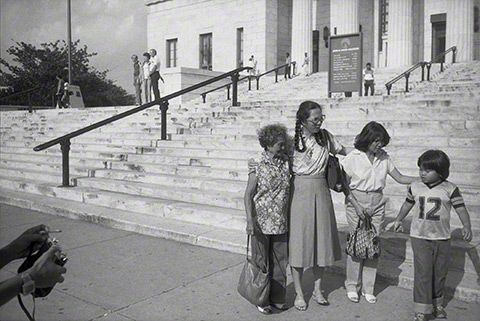
Family Picture, Field Museum, Chicago, Illinois, 1981

  I take solace in the fact that the photographer is not annoyed by his family and No.12. The protagonist enjoys a cigarette as he fumbles to work the camera controls. I, as the photographer and narrator of this grand play, both figuratively and literally work the border of my camera’s frame to reorganize those facts into a private moment of a different organization, a picture.

©Craig Carlson 2012 All Rights Reserved
18. February 2012 · · Categories: All

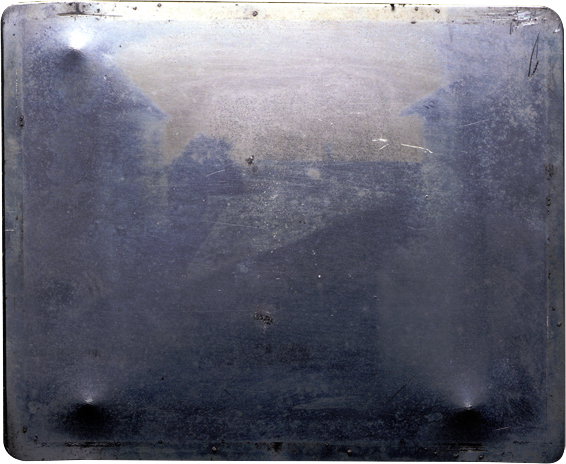
Joseph Nicéphore Niépce‘s Court Yard, 1826, Bitumen Of Judea On Pewter, 8×10″

  The first permanent photographic subject was Joseph Nicéphore Niépce’s court yard in 1826. His Heliograph was made on a sheet of pewter covered with bitumen of Judea, a light sensitive resin that hardened when exposed to light. Niépce’s exposure was so long (eight to ten hours) that the sun moving across the sky created shadows on both sides of the courtyard and the vertical line on the left is actually a tree.

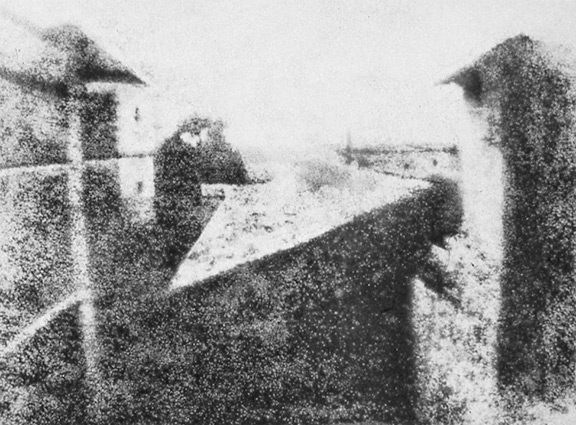
  The view was made from an upper, rear window of the Niépce family home in Burgundy, in the village of Saint-Loup-de-Varennes near Chalon-sur-Saône. Representationally the subject matter includes [from left to right]: the upper loft (or, so-called “pigeon-house”) of the family home; a pear tree with a patch of sky showing through an opening in the branches; the slanting roof of the barn, with the long roof and low chimney of the bake house behind it; and, on the right, another wing of the family house. Details in the original image are very faint, due not to fading—the heliographic process is a relatively permanent one—but rather to Niepce’s underexposure of the original plate.

  Niépce’s courtyard image is not a photograph. It was not until 1840, after the announcement of the Daguerreotype (the first commercially successful imaging process), that Henry Fox Talbot, an English entrepreneur invented the positive/negative process (photograph) called the Calotype. The Calotype (Talbotype) being a positive/negative process allowed the photographer to express himself by manipulating the image during printing, controlling local areas of the print to be lighter or darker. It also allowed multiple images to be composited on the same photographic paper. This was not possible with the Daguerreotype process because it did not make a negative and was an in-camera image which flipped the image horizontally.

first_photograph_home_trans

Nicéphore Niépce’s, Original Court Yard Photograph Made In 1826

  Helmut Gernsheim brought Niépce’s image to prominence again in 1952 and the Eastman Kodak Company was able to make a reproduction. In 1973, the University of Texas acquired the plate from Helmut Gernsheim. The first permanent photochemical image in the history of the world by Nicéphore Niépce’s, is on display at the Harry Ransom Humanities Research Center at the University of Texas at Austin.

©Copyright Craig Carlson All Rights Reserved