22. May 2012 · · Categories: All

Editing Your Photographs: Be Indifferent

As a photographer, editing your work is a critical step in understanding the process of image making. I tell my students, it makes no sense to delete any images while photographing with a digital camera, why?
As Kenny Rodgers suggested in is tune “The Gambler,”
You never count your money when you’re sittin’ at the table,
There’ll be time enough for countin’ when the dealin’s done.

What I mean by Kenny Rodger’s song, is that when your dealin as a photographer you are occupied with capture (taking pictures). What you have pointed your camera at has taken over every impulse of your mind’s eye. Besides an occasional look at your histogram to see if you are getting the information between the goal posts, and possibly how the light looks, there is no reason to do any more counting on your LCD; definitely not making any attempt at editing your work by swiping the delete button.

After capture, you can follow a simple workflow by downloading your images with Photoshop’s Bridge. Using the star system, give one star for yes, and two stars for maybes. Group those “Yeses” and “Maybes” with Bridge’s Output Panel into 20 images per proof sheet.
Here comes the part which is the most difficult: look at your photographs as if someone else made them. Or, remove your emotions from your pictures; be indifferent.

Walker Evans was a master at being indifferent to his work. Evans wasn’t interested what he felt a picture said to him, he was interested in what the facts inside the picture said to him. In order to separate his emotions from his pictures, street photographer Gary Winogrand put his exposed rolls of film aside for months before processing the film. Obviously, in the digital world of instant image thumbnails on your DSLR, this can be a difficult task.

Take a moment to write about your images as if you were a disinterested observer.

From your Yes and Maybe proof sheets, jury the frames which speak directly about your subjects meaning and its form. Make small high quality prints, and leaving room to write about them, glue-stick them onto letter size index card stock. Now, write a few sentences about the photographs as if they were made by another photographer. This process will allow you to judge your best images. The editing part of image making takes time, and as Henri Cartier-Bresson said, “It takes a lot of milk to make a little cheese.”

                                       All Content ©Copyright Craig Carlson 2012
11. May 2012 · · Categories: All

My First Photography Lesson
Since I was born in November, I spent most of 1963 as a twelve year old. The best place for twelve year olds after school was The Boys Club. A Sears parking lot now occupies the place were the Boys Club stood.

  It was single story fun house, and when you walked in you had to show your bakelite membership card at the front desk. Off to the left was the gymnasium, where I saw a man climb a rope to the ceiling of the gym, using only his hands, no assist from his feet, just hands; WOW, I thought only monkeys could do that.

  To the right of the entrance was the game room and library, yep, with books and desks to read them at, “No Talking Allowed.” I saw kids playing chess in there, nope, that’s not for me. Heading away from the library was the wood shop, it had all the tools to build projects with the help from an instructor. On Saturday mornings, (which was the best day of the week at the club) you could build a balsa wood racing car in the wood shop. Then, by mid morning, they would have races. You could buy for a quarter, a small bottle of compressed gas, and put your race car on a string, and race against other balsa wood cars. These small cars would blast across the pavement at light speed. When I was twelve, the Boys Club made me King of the world. It’s good to be King, at least once in your life.

  There was one other part of the Boys Club which had come to mean more to me than all the games, balsa wood race cars and gymnasiums. It was a small room in the back, near the wood shop which had a door with the name “DARKROOM” on it.

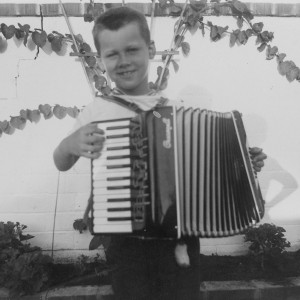
Boys Club Years (Age 8)

  On Tuesday nights, a sales representative of the Dupont Photographic Division (now defunct) would teach us photography. He showed us how to load 4×5″ film holders, make prints from a gloriously beautiful black and white paper called, “Dupont Velour Black.” No photographic paper, in the nearly fifty years of my darkroom experience has there been any paper with richer, more gradient mid tone values than Velour Black. We were tested on our photographic knowledge, before we were allowed to use the darkroom and enter photographic contests.

  I still remember the face of my first photography instructor. He kinda looked like Cary Grant, but with lighter hair and he was a smoker and had a very serious demeanor when it came to teaching photography. I remember the last time I saw him, I told him I knew everything about photography and he should let me use the darkroom anytime I wanted. He chuckled a bit at my absurd posturing, and told me, “he didn’t even know everything about photography,” I wonder if he knew, how important my only true professor of photography would be to a twelve year old.
                                   All Content ©copyright Craig Carlson 2012 All Rights Reserved