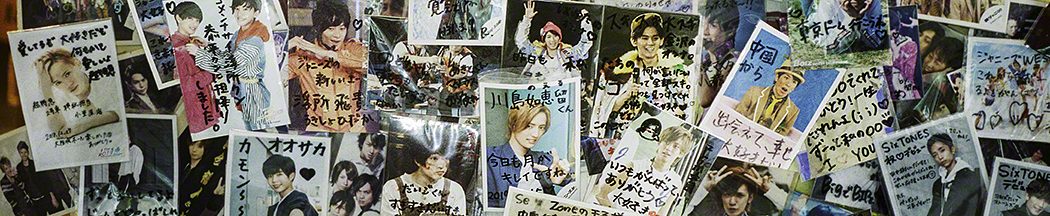
Sunset Boulevard Project, First Post, Los Angeles, California, 1-3-12
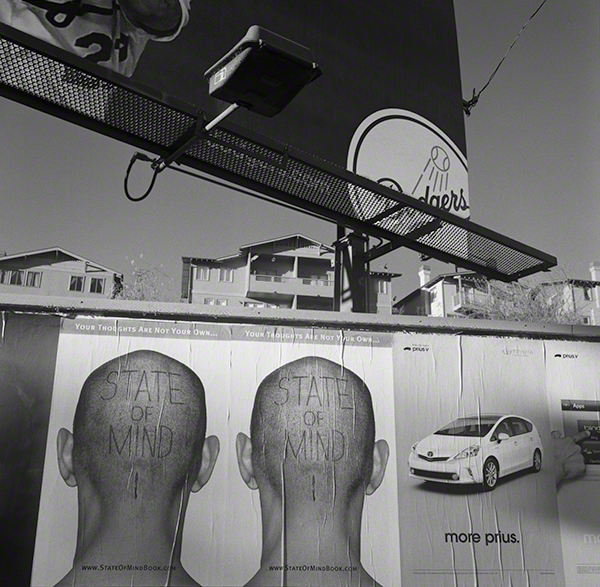
2012n005_02_state-of-mind

Along Sunset Boulevard, Los Angeles, California

    The process of capturing images for “Sunset Boulevard” involves photographing on nearly-abandoned urban streets. I’ve found that this is best done on holidays that also happen to land on Sundays. Fortunately on these days there are no parking issues; I can pull over, park, shoot, and make U- turns without having to dodge much traffic. The few people I see that early in the morning are mostly homeless, early workers waiting for the bus, or those headed to coffee houses opening up.

   The morning starts before dawn (this particular time at an IHOP), where I journal into my work binder what I hope to get done. My “working” three-ring binder is separated by tabs identifying the day of the shoot and it will also carry the processed 21/4″ x 21/4″ negatives and inexpensive digital proof sheets of each roll of film. At the end of each year, the contents of the binder(s) will be transferred to archival clamshell-style boxes with shooting dates pasted to their spines.
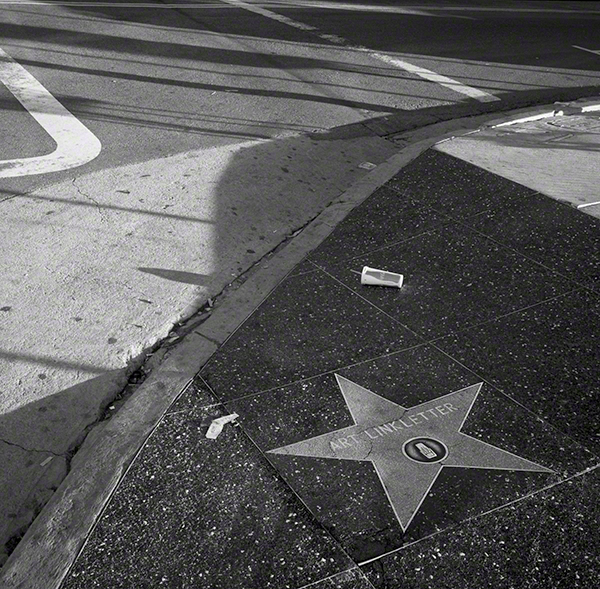
2012n010_02_art-linkletter-star

Art Linkletter Star, Near Sunset Boulevard & Vine Street, Los Angeles California

   For this project, I am using Mamiya Twin-Lens-Reflex cameras on a tripod and with focal lengths which allow me to shoot from the curb. For farther away subjects I will switch to another Mamiya with a normal lens. Technically, I shoot with Kodak TRI-X-Pan film with a yellow-orange filter to help create more contrast than the directional lighting (see directional lighting) I love working with. These types of projects help fill the space between the time I can get back to a larger subject or setting, such as Montana. It also allows me to continue looking and working with a minimum budget of gas, film, and an IHOP.

See Sunset Boulevard Gallery

 All Content ©Copyrighted Craig Carlson 2012 All Rights Reserved
30. December 2011 · · Categories: All

In The Beginning – My First Meaningful Photograph

  I was a senior in High School in June of 1968. I went to work in a pizza restaurant to earn enough money (minimum wage in 1968 was $1.65) to purchase a Mamiya C220 Twin-Lens-Reflex camera. It was really my first professional camera with adjustable aperture and shutter, and it shot medium format film (120) which I processed in a darkroom built by father.
I was fortunate that year to have a great teacher for my government class, John Cummings, who taught me the issues which faced America during the Vietnam War. He loved Robert Kennedy and the courage Kennedy had shown as Attorney General against organized crime and the vision of a more just America.

  Even though I was not old enough to vote in the upcoming presidential election (twenty-sixth amendment was adopted in 1971, allowing 18-yr-olds to vote), Mr. Cummings had made me aware of our political system, and the need to listen to what politicians say and do.

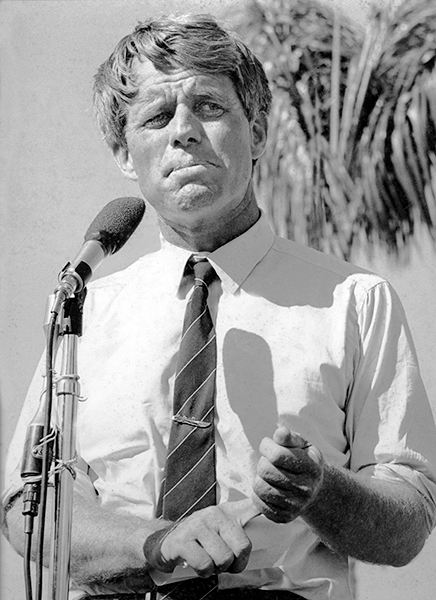
  In early June 1968, Robert Kennedy was campaigning for the California primary and was making a campaign stop in Chula Vista, California, and Kennedy’s speech was scheduled in the afternoon of June 3rd, in front of the Mayors office. I remember that a small crowd of less than a 100 people came to hear Kennedy speak. He was wearing a white shirt and a tie clasp which was an image of his brothers torpedo boat, the PT-109. Someone yelled during the speech that Kennedy, “outta get a haircut.” I also was fascinated by Kennedy’s campaign photographer who was working with a smaller 35mm Single-Lens-Reflex camera, he shot quickly and then moved to different vantage points as if he knew what he was doing. Kennedy’s photographer also needed a haircut.

Robert Kennedy, Campaign Stop, Chula Vista, California, Monday June 3, 1968 by Craig Carlson

  On June 4th, after watching the election results late into the night, I went to bed, but remember waking up around 12:00 AM and turned on the radio. The radio broadcast was from the Ambassador Hotel in Los Angeles, the broadcast was hard to hear and sounded like Pandemonium at the hotel; soon a radio reporter announced the assassination attempt on Robert Kennedy. Kennedy died from multiple gun shot wounds 26 hours later in the early morning hours of June 6th. My photograph of Robert Kennedy as a high school senior was a gateway to a life in photography, and the meaning of,  “ƒ/8 and being there.”

  On returning to school the following day after the assassination, I saw Mr. Cummings my government teacher, sitting outside the classroom in a student desk. He was in shock, and in deep grief over the killing of someone he deeply admired.
In 1968 the world would also grieve for the passing of writers, John Steinbeck, Upton Sinclair and beat writer Neal Cassady, Jack Kerouac’s muse for his novel, “On The Road.” I would also be saddened by the passing of the man who built my darkroom, my father, who died at age 52.

All Content ©Copyrighted Craig Carlson 2012